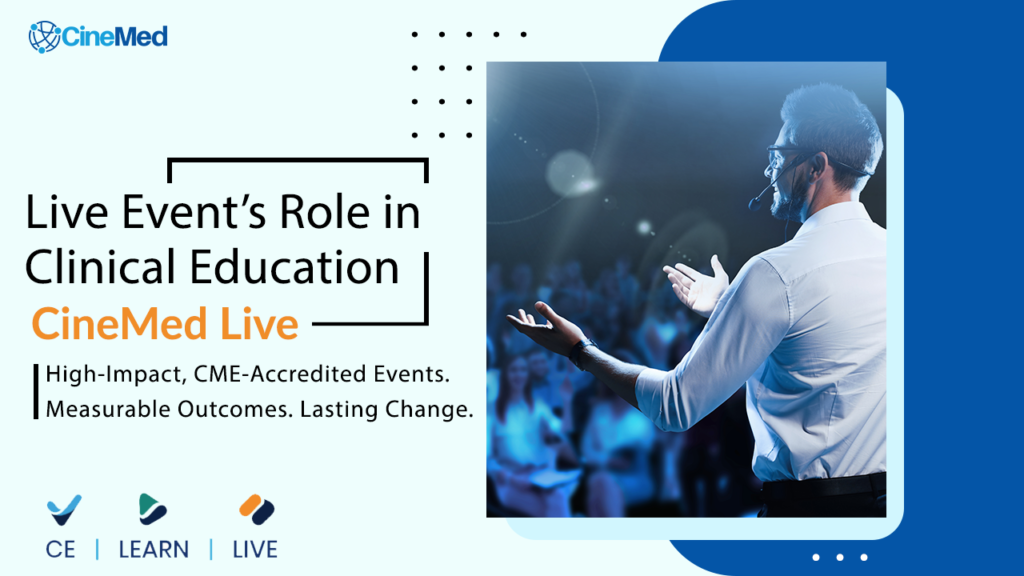
CineMed Live: The Role of Live Events in Clinical Education
Medical residents overwhelmingly prefer in-person conferences to virtual alternatives, yet healthcare organizations increasingly struggle to execute live CME events that meet accreditation requirements while delivering measurable educational impact.
A 2024 study published in JB JS Open Access found that 85% of orthopedic surgery residents prefer in-person educational conferences, citing hands-on learning opportunities and professional networking as primary drivers.
CineMed Live addresses this reality through turnkey event management that handles operational complexity while ensuring accreditation compliance, allowing healthcare organizations to focus on what matters most: advancing clinical practice through exceptional education.
Why Do Live Events Remain Essential for Clinical Education?
Despite the digital transformation reshaping healthcare education, certain learning objectives simply cannot be achieved through screens alone.
Procedural skills requiring precise technique, interprofessional collaboration demanding real-time coordination, and the tacit knowledge transferred through expert mentorship all depend on physical presence and hands-on engagement that no virtual platform can replicate.
The research supporting live education’s unique value continues to strengthen. A comprehensive review published in Medicine examining simulation-based training across medical education found that these approaches effectively build clinical skills, enhance learner confidence, and reduce errors in ways that passive learning modalities cannot match.
The study emphasized that procedural competency development requires deliberate practice with immediate feedback. Conditions are optimized in live training environments where experts can observe technique, correct errors in real time, and ensure proper skill acquisition before clinical application.
Beyond procedural training, live events facilitate the informal knowledge exchange that shapes clinical careers.
The 2024 JB JS study found that networking opportunities ranked among the top reasons residents preferred in-person conferences, with participants valuing the mentorship connections, collaborative relationships, and career guidance that emerge from face-to-face professional interaction.
These benefits extend throughout careers. The colleagues met at conferences become referral partners, research collaborators, and trusted advisors for challenging clinical situations.
The evidence supporting live education’s impact encompasses multiple dimensions of professional development:
- Skill acquisition superiority: Research published in World Journal of Advanced Research and Reviews confirms that simulation-based training demonstrates significantly better outcomes than lecture-based instruction for developing and maintaining clinical skills, with effects persisting long after training completion.
- Interprofessional collaboration: A study in Nurse Education Today found that simulation-based interprofessional education improves team communication and coordination—competencies essential for modern healthcare delivery that require practicing together in realistic scenarios.
- Engagement and satisfaction: The JB JS research found that 91% of in-person conference attendees would choose that format again, indicating exceptional satisfaction with the live learning experience.
- Knowledge application: Research examining CME effectiveness found that interactive educational formats, characteristic of well-designed live events, demonstrate significantly greater impact on physician practice and patient outcomes than passive didactic presentations.
CineMed Live builds on these research foundations to deliver events that maximize educational impact while handling the operational complexity that prevents many organizations from offering live programming.
As explored in Building Tomorrow’s Healthcare Education: The CineMed Vision, effective medical education requires integration across modalities. Live experiences, digital reinforcement, and a robust accreditation infrastructure must work together to turn learning into lasting practice change.
How Has the Hybrid Model Transformed Live Medical Education?
The rigid binary between in-person and virtual education has dissolved into flexible hybrid models that serve diverse learner needs without forcing compromise.
Healthcare professionals can now access the specific educational experiences that match their learning objectives, scheduling constraints, and geographic realities.
They can attend hands-on workshops in person while joining didactic sessions remotely or participate fully in multi-day conferences without the travel burden that once created barriers to attendance.
Research validates the hybrid approach’s effectiveness and learner preference.
A 2024 study published in BMC Medical Education surveying conference attendees found that 56.9% preferred hybrid formats over exclusively in-person or virtual options.
The study revealed that learners appreciate the flexibility to choose their participation mode based on session type and personal circumstances. This insight has significant implications for organizations designing comprehensive educational programming.
The same research identified important differences in why learners choose each modality.
- In-person attendees prioritized networking opportunities, hands-on learning, and collaborative engagement.
- Virtual participants valued convenience, accessibility, and the ability to participate despite geographic or scheduling constraints.
- Hybrid events serve both populations simultaneously, expanding educational reach without diluting the high-touch experiences that make live learning valuable.
The accessibility advantages of hybrid programming extend beyond convenience to genuine equity in educational opportunity:
- Geographic inclusion: Healthcare professionals in rural or underserved areas can access expert education without prohibitive travel costs or extended time away from clinical responsibilities that understaffed facilities cannot absorb.
- Schedule flexibility: Emergency physicians, hospitalists, and others with unpredictable schedules can participate in sessions despite last-minute clinical demands that might otherwise cause complete conference absence.
- Budget optimization: Organizations reach larger audiences without proportionally increased venue, catering, and logistics costs, maximizing educational investment impact.
- Content longevity: Recorded sessions enable asynchronous access, allowing learners who missed live presentations to engage with content at convenient times while extending the educational impact far beyond event dates.
The BMC Medical Education study offered specific recommendations for hybrid conference design, emphasizing the importance of dedicated networking time for in-person attendees, interactive elements that engage virtual participants, and clear communication about which sessions offer particular value for each attendance modality.
These design principles inform CineMed Live’s approach to hybrid event planning, ensuring both in-person and virtual attendees receive experiences optimized for their participation mode.
What Types of Live Events Drive Clinical Excellence?
CineMed Live delivers comprehensive event management across the full spectrum of live medical education. From intimate procedural workshops requiring specialized equipment and expert faculty to large-scale conferences serving hundreds of attendees across multiple tracks.
CineMed’s live learning formats means we can meet any learner where they are in their specific journey. Each format serves distinct educational objectives while sharing common requirements for accreditation compliance, logistical excellence, and measurable outcomes.
Hands-On Procedural Workshops
Procedural skills cannot be mastered through observation alone, they require deliberate practice with expert guidance and immediate corrective feedback.
CineMed procedural workshops create controlled environments where healthcare professionals develop and refine clinical techniques before applying them in patient care settings, eliminating the risk inherent in learning new procedures on actual patients.
The research supporting simulation-based procedural training is unequivocal. The Medicine review found that simulation training improves clinical skills, builds confidence, and reduces errors—outcomes that translate directly into improved patient safety and care quality.
Learners who practice procedures repeatedly in simulated environments develop the muscle memory, decision-making patterns, and complication-management skills that distinguish competent practitioners.
CineMed procedural workshops incorporate evidence-based instructional design elements:
- High-fidelity simulation: Realistic mannequins and simulation equipment replicate patient responses, allowing learners to experience the tactile and visual feedback essential for procedural mastery without patient risk
- Small-group instruction: Limited cohort sizes ensure every participant receives adequate practice time and individualized expert feedback rather than watching from the back of a crowded demonstration
- Structured skill assessment: Validated competency checklists document skill acquisition objectively, providing both learners and organizations with evidence of educational outcomes beyond simple participation
- Device training integration: When new medical devices require hands-on familiarization, structured training ensures healthcare professionals develop proficiency before clinical deployment
Industry-Supported Educational Programming
Commercial support enables educational programming that organizations might not otherwise afford—but only when managed with rigorous attention to independence and integrity. The ACCME Standards for Integrity and Independence establish clear requirements separating educational content from commercial influence, ensuring that industry-supported programming serves genuine learning needs rather than promotional objectives.
CineMed’s approach to commercially-supported education reflects four decades of experience maintaining the documented separation between funding and content that protects accreditation status and educational credibility:
- Independence documentation: Clear, auditable processes demonstrate that content development occurs independently of commercial supporter influence, with learning objectives derived from identified practice gaps rather than marketing priorities
- Faculty selection integrity: Expert faculty are selected based on clinical expertise and educational effectiveness, not industry relationships, with all relevant financial disclosures properly managed and mitigated
- Venue and logistics appropriateness: Event settings support educational objectives without the lavish hospitality that might suggest inappropriate industry influence or distract from learning
- Active learning formats: Case-based discussions, interactive workshops, and application exercises engage learners actively rather than subjecting them to passive promotional presentations masquerading as education
Large-Scale Conferences and Symposia
Multi-day conferences and specialty symposia require coordination across dozens of variables like venues, registration systems, faculty travel, audio-visual technology, catering, and the countless small details that determine whether attendees experience seamless learning or frustrating logistical obstacles.
Most healthcare organizations lack the specialized expertise and dedicated staff to manage this complexity while maintaining focus on their core clinical missions.
CineMed’s turnkey conference management handles every operational dimension, allowing organizational leadership to focus on strategic educational objectives while experienced event professionals manage execution details.
How Does Turnkey Event Management Eliminate Operational Burden?
Healthcare education leaders consistently identify event logistics as a primary barrier to offering live programming. This is not because organizations doubt live education’s value, but because they lack the specialized resources to execute events competently. The practical reality is that planning a successful CME event requires expertise spanning venue negotiation, registration technology, faculty coordination, audio-visual production, catering management, and regulatory compliance that most healthcare organizations don’t maintain internally.
Industry guidance on medical education event planning emphasizes the comprehensive nature of successful event execution from needs assessment and gap analysis through vendor management, budget oversight, and post-event evaluation.
Each element requires specific expertise that conferences or events may demand only occasionally but must be executed flawlessly when needed. Organizations attempting to develop this expertise internally typically find the learning curve steep and the resource investment disproportionate to event frequency.
CineMed Live’s turnkey model addresses this reality through comprehensive event services that leverage 40+ years of healthcare education experience:
- Venue sourcing and negotiation: Established relationships with hotels, conference centers, and medical facilities provide access to appropriate spaces at favorable rates, with contract terms that protect organizational interests and accommodate the specific requirements of medical education programming
- Registration and attendee management: Professional registration systems handle enrollment, confirmation, attendance tracking, and credit processing, ensuring participants experience seamless engagement from initial sign-up through certificate delivery
- Audio-visual and technology coordination: Whether events require simple presentation support or complex hybrid broadcasting infrastructure, experienced technical teams ensure equipment functions properly and backup systems stand ready
- Catering and hospitality: Meal planning, dietary accommodation, and food service coordination maintain attendee comfort without the lavish hospitality that might raise compliance concerns for industry-supported programming
- On-site staffing: Trained event professionals manage check-in, wayfinding, troubleshooting, and the thousand small details that distinguish professional events from amateur efforts
- Faculty coordination: Speaker recruitment, contract management, travel logistics, and honorarium processing respect faculty time while ensuring smooth participation
This comprehensive approach allows healthcare organizations to offer live programming that meets professional standards without diverting clinical staff from patient care responsibilities or building internal event management capabilities they’ll rarely use.
How Do You Measure Whether Live Education Actually Works?
Completion certificates and satisfaction surveys represent the minimum threshold for educational documentation, not the standard for demonstrating genuine impact.
Organizations investing in live CME increasingly face leadership questions about educational return on investment that cannot be answered by counting attendees or averaging evaluation scores. The question that matters is whether education actually changed practice and improved patient care.
A landmark study published in Academic Medicine examined commitment-to-change as a predictor of physician behavior modification following CME lectures. The findings were striking: 91% of physicians who documented specific commitments to change their practice actually implemented those changes within one week.
Among those who attended without making explicit commitments, only 32% changed their practice.
This research has profound implications for CME program design and measurement. Events structured to elicit specific, documented commitments,rather than simply exposing learners to information, demonstrate dramatically higher practice change rates.
CineMed Live incorporates commitment-to-change protocols and follow-up mechanisms that translate educational exposure into documented behavior modification.
A comprehensive review by Cervero and Gaines examining CME’s impact on physician performance and patient outcomes found that continuing education represents one of the most effective interventions for translating medical knowledge into clinical practice.
The review emphasized that interactive educational formats, practice-based application, and reinforcement over time significantly enhanced CME effectiveness—characteristics that well-designed live events deliver more effectively than passive online alternatives.
CineMed Live’s measurement framework addresses multiple levels of educational impact:
- Participation documentation: Beyond simple attendance counts, detailed tracking captures session-level engagement, activity participation, and time investment across event components
- Knowledge assessment: Pre- and post-event testing quantifies knowledge acquisition, identifying both individual learning and content areas requiring reinforcement or revision
- Skill demonstration: For procedural workshops, competency checklists document observable skill performance against validated standards
- Satisfaction measurement: Learner evaluations assess content quality, faculty effectiveness, logistics execution, and perceived value—important feedback for continuous improvement even if insufficient alone for demonstrating impact
- Practice change tracking: Follow-up surveys administered weeks or months after events assess whether learners implemented intended changes, providing the practice-level data that demonstrates genuine educational effectiveness
- Comprehensive reporting: Documentation packages meet requirements for ACCME, ANCC, and AAPA while providing organizational leadership with the outcome data needed to justify educational investments
This outcomes-oriented approach aligns with the comprehensive framework we outlined for accreditation confidence, where measurement and documentation serve both compliance requirements and strategic demonstration of educational value.
How Does CineMed Live Connect to Comprehensive Healthcare Education?
Live events achieve maximum impact when integrated with broader educational infrastructure rather than operating as isolated experiences.
The practice change research demonstrates that reinforcement over time significantly enhances CME effectiveness, a finding that argues for connecting live learning with digital follow-up, spaced reinforcement, and ongoing competency development rather than treating conferences as standalone educational moments.
CineMed Live operates as one pillar within CineMed’s integrated three-pillar framework, working alongside CineMed CE for accreditation management and CineMed Learn for digital education delivery. This integration enables educational strategies that combine modalities for maximum impact:
- Pre-event preparation: Online modules delivered through CineMed Learn establish foundational knowledge before live events, allowing in-person time to focus on application, practice, and advanced concepts rather than basic content delivery
- Live experience optimization: With foundational content addressed digitally, live programming can emphasize the hands-on practice, expert interaction, and peer collaboration that justify in-person participation
- Post-event reinforcement: Digital micro-modules reinforce key concepts from live sessions, defeating the forgetting curve that otherwise erodes learning within weeks of conference attendance
- Unified accreditation: CineMed CE’s joint accreditation from ACCME, ANCC, and AAPA covers all modalities, eliminating the fragmented compliance management that burdens organizations working with multiple providers
- Comprehensive analytics: Integrated data across live and digital touchpoints provides complete visibility into educational engagement and impact, supporting both program improvement and ROI demonstration
This connected approach reflects recognition that lasting practice change requires more than isolated educational exposures—it demands systematic reinforcement and integration that sustains learning over time.
Ready to Deliver Live Education That Drives Practice Change?
Live events create educational experiences that digital delivery cannot replicate—the procedural mastery built through hands-on practice, the professional relationships forged through in-person networking, and the engaged learning that emerges from real-time expert interaction.
These experiences shape careers and ultimately improve patient care in ways that justify the complexity of live event execution.
CineMed Live eliminates the operational barriers that prevent healthcare organizations from offering live programming, handling logistics from venue selection through post-event reporting while maintaining the accreditation compliance that protects organizational credibility.
Whether the educational objective requires intimate procedural workshops or large-scale conferences, CineMed’s 40+ years of healthcare education experience ensure professional execution that reflects positively on hosting organizations.
The integration advantage extends beyond individual events to comprehensive educational strategy. With accreditation through CineMed CE, digital content through CineMed Learn, and live experiences through CineMed Live, organizations gain unified visibility into educational impact across all modalities.
Frequently Asked Questions
What types of healthcare professionals can earn credits through CineMed Live events?
CineMed maintains joint accreditation from ACCME, ANCC, and AAPA, enabling credit awards for physicians, nurses, physician assistants, and pharmacists through single events. This multi-accreditation capability supports the interprofessional education increasingly essential for team-based care delivery, allowing organizations to serve diverse professional audiences without coordinating separate accreditation providers for each discipline.
How far in advance should organizations begin planning live CME events?
Large conferences and hybrid events benefit from 6-12 months of planning time, allowing adequate runway for venue contracting, faculty recruitment, and promotional activities that maximize attendance. Smaller programs such as dinner symposia or focused workshops typically require 3-4 months. CineMed’s turnkey approach consolidates coordination that might otherwise extend timelines, but earlier engagement consistently provides more venue options, better faculty availability, and stronger promotional results.
Why are hybrid events more effective than single-format programming?
Research demonstrates that different learners have different needs that hybrid formats serve simultaneously. Studies show 85% of medical residents prefer in-person attendance for networking and hands-on learning, while other professionals face geographic, scheduling, or budget constraints that make travel impractical. Hybrid events reach both audiences without compromise, expanding educational access while preserving the high-touch experiences that make live learning valuable for those who can attend in person.
How does CineMed ensure commercial support doesn’t influence educational content?
CineMed follows rigorous ACCME Standards for Integrity and Independence through documented processes that maintain complete separation between commercial supporters and content development. Learning objectives derive from identified practice gaps, not sponsor priorities. Faculty selection reflects clinical expertise and educational effectiveness, not industry relationships. All financial relationships receive proper disclosure and mitigation. This systematic approach has maintained CineMed’s unblemished accreditation record across more than 40 years of commercially-supported programming.
What outcomes data does CineMed provide following live events?
CineMed Live delivers comprehensive reporting including participation documentation, knowledge assessment results, satisfaction metrics, and practice change tracking. These analytics address both ACCME compliance requirements and organizational leadership needs for ROI demonstration. The integrated data infrastructure connecting live events with CineMed CE and CineMed Learn provides complete visibility into educational impact across modalities—essential for justifying investments and guiding strategic program development.
Works Cited
Burns, L. E., et al. (2024). Physician preferences for online and in-person CME. BMC Medical Education. https://doi.org/10.1186/s12909-024-06046-1
Cervero, R. M., & Gaines, J. K. (2015). The impact of CME on physician performance and patient outcomes. Journal of Continuing Education in the Health Professions. https://doi.org/10.1002/chp.21290
Elendu, C., et al. (2024). The impact of simulation-based training in medical education. Medicine. https://doi.org/10.1097/MD.0000000000038813
Mansouri, M., & Lockyer, J. (2011). Commitments to change following CME lectures. Academic Medicine. https://doi.org/10.1097/ACM.0b013e318226cdf5
Ofosu-Asare, E., et al. (2024). Simulation-based training effectiveness. World Journal of Advanced Research and Reviews. https://doi.org/10.30574/wjarr.2024.21.1.0163
Ram, S. S., et al. (2024). How should future hybrid conferences be designed? BMC Medical Education. https://doi.org/10.1186/s12909-024-05351-z
Sezgin, G., & Baydin, H. (2023). Interprofessional simulation-based education. Nurse Education Today. https://doi.org/10.1016/j.nedt.2022.105619
Staunton, C. A., et al. (2024). Residents prefer in-person conferences. JB JS Open Access. https://doi.org/10.2106/JBJS.OA.24.00014
ACCME. (2024). Standards for integrity and independence. https://accme.org/accreditation-rules/standards-for-integrity-independence-accredited-ce
CineMed has provided accredited healthcare education for over 40 years, serving leading medical societies, healthcare systems, and industry partners through our integrated CE, Learn, and Live service pillars. For more information, visit cine-med.com.